
Bingo Cards Explained: 24 Numbers, Five Columns, One Free Space
By Bingo PH Editorial Team
- 21+ onlyPAGCOR keeps anyone under 21 away from the gaming it licenses, bingo included, so each page is pitched at grown-ups. Not 21 yet? Come back on the day you are.
- Calls traced to a sourceA rule, a count or a prize figure shows up only when PAGCOR or a studio prints it, or when the sum is laid out in front of you. What nobody publishes gets the words "not published".
- No operator namedNo hall, app or casino is named, scored or ranked on these pages. They explain bingo and nothing else: no stakes taken, no balances held, no promise of a win.
Bingo cards: what is printed on one
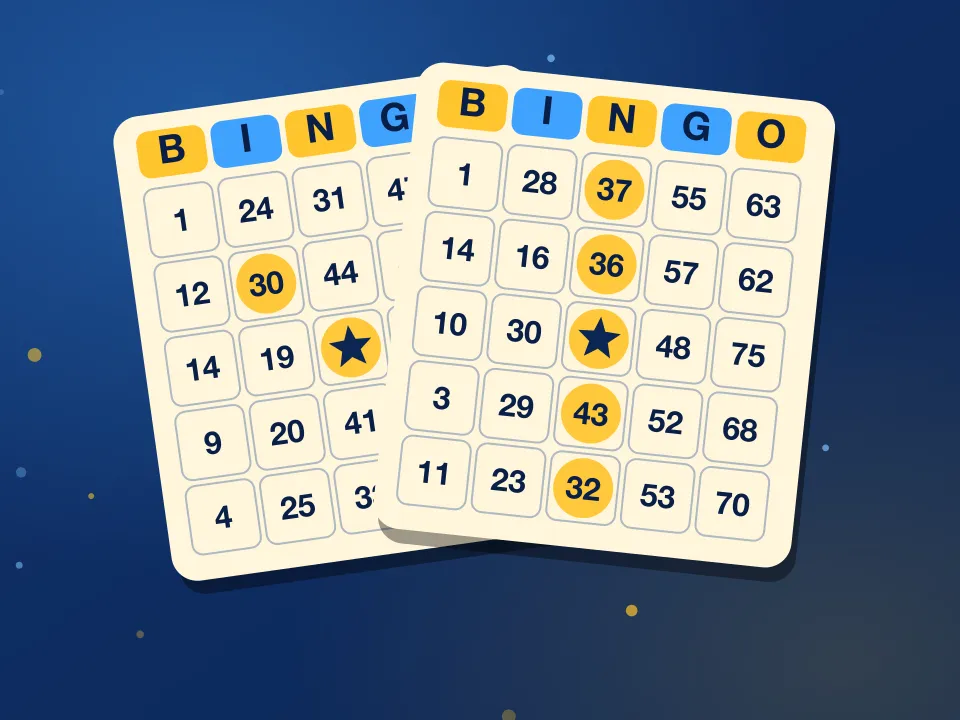
Pick up a 75-ball card and five columns greet you, headed B, I, N, G and O. Each column has five squares, except that the middle of the N column is a free space, so 24 squares carry numbers. Every number must sit in the column that matches its range, which is why a 7 never appears under G.
| Column | Number range | Squares |
|---|---|---|
| B | 1 to 15 | 5 |
| I | 16 to 30 | 5 |
| N | 31 to 45 | 4 plus the free space |
| G | 46 to 60 | 5 |
| O | 61 to 75 | 5 |
A hall’s bingo program also records the card colour or design, the faces on each sheet and the price, so two cards that look alike may belong to different games.
Four pages for the card itself
| Page | What it covers |
|---|---|
| Bingo card numbers | The column ranges and how many different cards exist |
| 90 ball bingo tickets | The 3x9 strip and how six tickets share the numbers |
| Bingo chips | Markers, daubers and what the rules allow |
| How to make bingo cards | Building a valid card by hand and counting the possibilities |
One card or many: what changes when you play more
Extra cards give more chances to complete the pattern in the same game, and they also multiply the money you stake. If 40 of 1,000 cards in play are yours, you hold 4% of the cards, and on equal chances you take about 4% of the winning chances. That is an Example with a stated assumption, not a promise.
PAGCOR’s rules add two limits worth knowing. Split cards cut from a larger multi-faced card are not entitled to win, and the card must be valid at the check. The card also needs to be yours: a player signs a printed name on the back where the rules require it.
Cards are cheap per piece and expensive in volume. Decide how many you will buy before the session, not during it, and read how many bingo cards to play for the arithmetic of adding a second card.
Choosing cards at the table without second-guessing
A card is a fixed object once you have it: nothing on it changes during the game except your marks. So the choice happens at the counter. Look at the sheet or screen and check that it matches the game’s format, because a 75-ball card will never work in a 90-ball game.
Keep your cards where you can read them in order. Many players lose a game not to bad luck but to a number marked on the wrong card. If you play several, mark one number across all of them before the next call, then move on.
Chips and daubers are a matter of comfort. A dauber leaves a clear mark that the floor staff can read, while a chip is easy to knock off. PAGCOR’s rule is that the pattern must be covered by dauber or pen, so check what the hall expects before you rely on loose markers.
Finally, treat the printed number of cards as a budget line. If you set aside PHP200 for the session and a card costs more than you planned, buy fewer cards rather than adjusting the limit.
A short note on 90-ball tickets
Not every ticket is a 5x5 card. A 90-ball ticket is a grid of 27 squares laid out as 9 columns and 3 rows, with 15 numbers and 12 blanks, and each row holds five numbers. Columns follow the tens, from 1 to 9 up to 81 to 90. Tickets are sold in strips of six, and across a strip every number from 1 to 90 appears once.
Prizes in that game go to one line, then two lines, then a full house. Because the grid is different, the odds are different too, and the 90-ball tickets page explains how. In the Philippines, the 75-ball card is the one PAGCOR’s framework describes for traditional bingo.
Reading the numbers printed on a card
Every number on a 75-ball card is unique within its card. A column never repeats a number, and a number never moves to another column. That gives a quick check when you suspect a misprint: if you see a 52 under the I column, the card is not valid. The same check helps when you are making cards by hand, because a card that breaks the column rule cannot win.
A 75-ball card shows 24 numbers across 5 rows, and no number repeats.
Call it in three moves
-
Hear the call
Start with the plain statement: the pattern name, the rule or the figure the source actually prints. Skip the rumours and the stories that start with someone I know.
-
Find it on your card
Lay that statement over a 5x5 card. Count the squares it needs, check whether the free space counts, and you know how far you are from calling it.
-
Take the tip
Decide your card budget before the first number is called, and stop when it is spent. A bingo night is paid entertainment, never income.