
Four Corners Bingo: Cover the Four Corner Squares
By Bingo PH Editorial Team
- 21+ onlyPAGCOR keeps anyone under 21 away from the gaming it licenses, bingo included, so each page is pitched at grown-ups. Not 21 yet? Come back on the day you are.
- Calls traced to a sourceA rule, a count or a prize figure shows up only when PAGCOR or a studio prints it, or when the sum is laid out in front of you. What nobody publishes gets the words "not published".
- No operator namedNo hall, app or casino is named, scored or ranked on these pages. They explain bingo and nothing else: no stakes taken, no balances held, no promise of a win.
Four corners bingo on the card
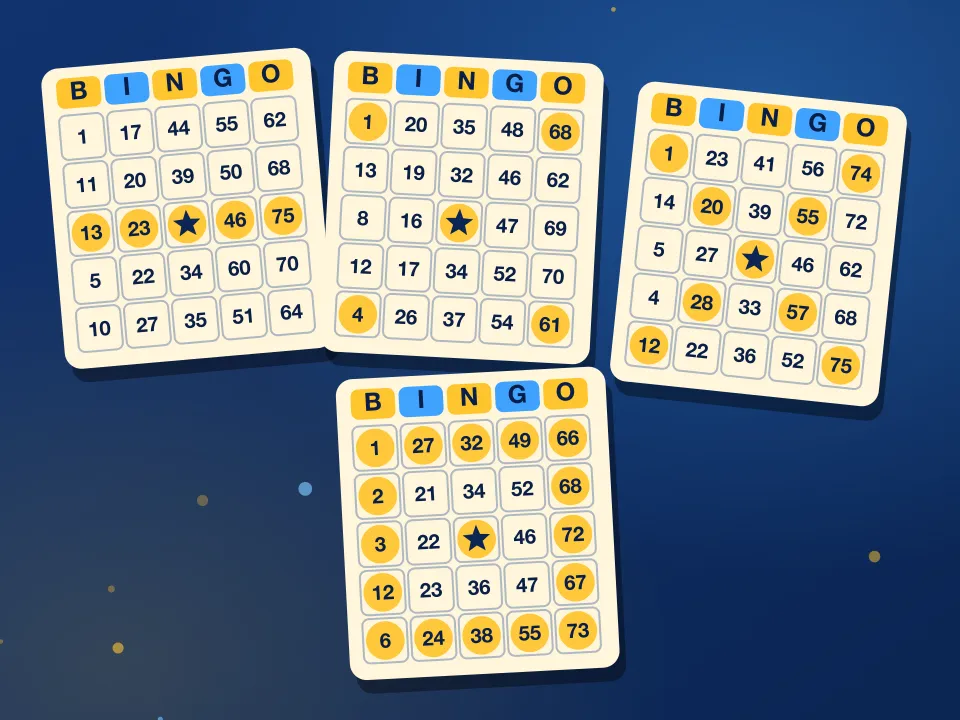
The corners are the top-left B number, the top-right O number, the bottom-left B number and the bottom-right O number. That is two numbers from 1 to 15 and two from 61 to 75.
| B | I | N | G | O |
|---|---|---|---|---|
| X | X | |||
| FREE | ||||
| X | X |
Four corners bingo odds: the numbers
The chance that all k needed numbers are out within n calls is C(75 minus k, n minus k) divided by C(75, n). For four corners k is 4.
| Calls | Chance for one card |
|---|---|
| 30 | about 2.3% |
| 50 | about 19% |
| 60 | about 40% |
The expected call for the last corner is 4 times 76 divided by 5, about 60.8. Each figure is an Example for one card in a fair draw, not a forecast for a room full of players.
Playing four corners in a continuous game
Because four corners finishes early, halls often use it as the first leg of a continuous game. After it, the same card plays on for a large frame and then coverall, and the balls already called stay called.
That means you keep your marks after the first win. Do not wipe the card when four corners ends, because the next pattern builds on the same numbers.
If you want the longer shapes, see picture frame bingo and blackout bingo, and for line patterns see single lines.
PAGCOR’s continuous example gives 3 stages, and the corners count as 4 of the 16 frame squares.
Where the corner numbers come from
The corners sit in the outer columns, so you need two B numbers from 1 to 15 and two O numbers from 61 to 75. That is worth knowing because it tells you where to listen: only calls with a B or an O can help.
Of the 75 balls, 30 belong to those two letters, so on average 2 in 5 calls are relevant to you. When the caller reads an N or a G, you can relax, since no corner square sits in those columns. Mark the ones that matter, and use the gaps to check your other cards.
Short patterns end suddenly, so keep your hand on the dauber and your eyes on the card.
The corners use 2 B numbers and 2 O numbers, out of 30 balls that carry those 2 letters.
PAGCOR’s continuous example opens with four corners, and 30 of 75 balls carry a B or an O.
Call it in three moves
-
Hear the call
Start with the plain statement: the pattern name, the rule or the figure the source actually prints. Skip the rumours and the stories that start with someone I know.
-
Find it on your card
Lay that statement over a 5x5 card. Count the squares it needs, check whether the free space counts, and you know how far you are from calling it.
-
Take the tip
Decide your card budget before the first number is called, and stop when it is spent. A bingo night is paid entertainment, never income.