
Double Bingo: What It Takes to Complete Two Lines on One Card
By Bingo PH Editorial Team
- 21+ onlyPAGCOR keeps anyone under 21 away from the gaming it licenses, bingo included, so each page is pitched at grown-ups. Not 21 yet? Come back on the day you are.
- Calls traced to a sourceA rule, a count or a prize figure shows up only when PAGCOR or a studio prints it, or when the sum is laid out in front of you. What nobody publishes gets the words "not published".
- No operator namedNo hall, app or casino is named, scored or ranked on these pages. They explain bingo and nothing else: no stakes taken, no balances held, no promise of a win.
Double bingo: counting the squares
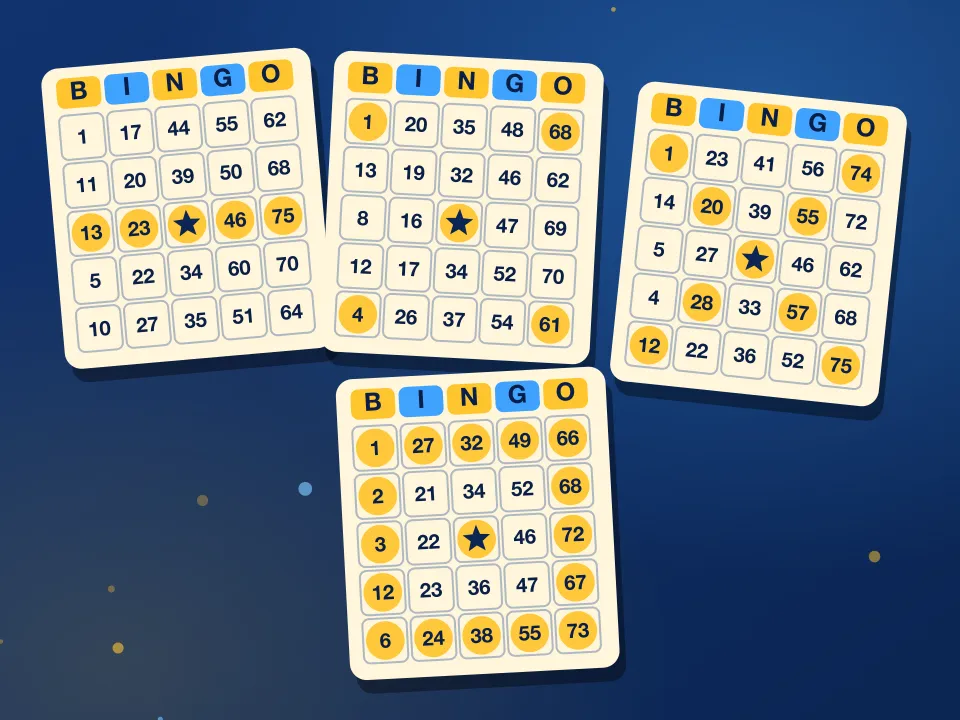
Two lines may share a square or may not, and the count of numbers needed follows from that.
| Two lines | Squares | Numbers needed |
|---|---|---|
| Two outer rows | 10 | 10 |
| Middle row plus middle column | 9, sharing the free space | 8 |
| Both diagonals | 9, sharing the free space | 8 |
Each line alone is 5 squares. Two that do not meet make 10. Two that meet at the free space make 9 squares, but the free space is pre-marked, so you need 8 numbers.
Double bingo odds
With k numbers needed, the expected last call is k times 76 divided by k plus 1, as an Example for one card in a fair draw.
| Case | k | Expected last call |
|---|---|---|
| Two outer rows | 10 | about 69.1 |
| Crossing lines or both diagonals | 8 | about 67.6 |
Doubling the line adds about six calls to the wait for a single 5-number line, about 63.3. That is the real cost of the second line.
Double lines in the program
PAGCOR’s framework words fixed straight lines as single or double, so a game that says double line wants two. In a multiple-prize game, each pattern carries its own prize, and a jackpot winner forfeits the consolation prize of that game.
Read the program for the exact rule. For single lines see the straight-line pattern, and for both diagonals see diagonal bingo.
Keeping track of two lines
Two lines mean two lists in your head. Say aloud which two lines you are chasing, such as the second row and the fourth column, and ignore the rest.
The risk is claiming too early. Having one line is not enough, and the program says the game needs two. A false claim is rejected, and the next ball is called, so a wrong shout costs you only the pause, but it also tells the room which numbers you hold.
If two lines cross, count the shared square only once. When the shared square is the free space, you have a head start of one.
Double games run longer than single-line games, so pace your cards and your budget.
Two lines of 5 squares need 10 numbers if they do not meet and 8 if they cross at the free space.
PAGCOR lists lines as single or double, and a double line is 2 lines on 1 card.
Call it in three moves
-
Hear the call
Start with the plain statement: the pattern name, the rule or the figure the source actually prints. Skip the rumours and the stories that start with someone I know.
-
Find it on your card
Lay that statement over a 5x5 card. Count the squares it needs, check whether the free space counts, and you know how far you are from calling it.
-
Take the tip
Decide your card budget before the first number is called, and stop when it is spent. A bingo night is paid entertainment, never income.

