
75 Ball Bingo: How the Card, the Letters and the Lines Work
By Bingo PH Editorial Team
- 21+ onlyPAGCOR keeps anyone under 21 away from the gaming it licenses, bingo included, so each page is pitched at grown-ups. Not 21 yet? Come back on the day you are.
- Calls traced to a sourceA rule, a count or a prize figure shows up only when PAGCOR or a studio prints it, or when the sum is laid out in front of you. What nobody publishes gets the words "not published".
- No operator namedNo hall, app or casino is named, scored or ranked on these pages. They explain bingo and nothing else: no stakes taken, no balances held, no promise of a win.
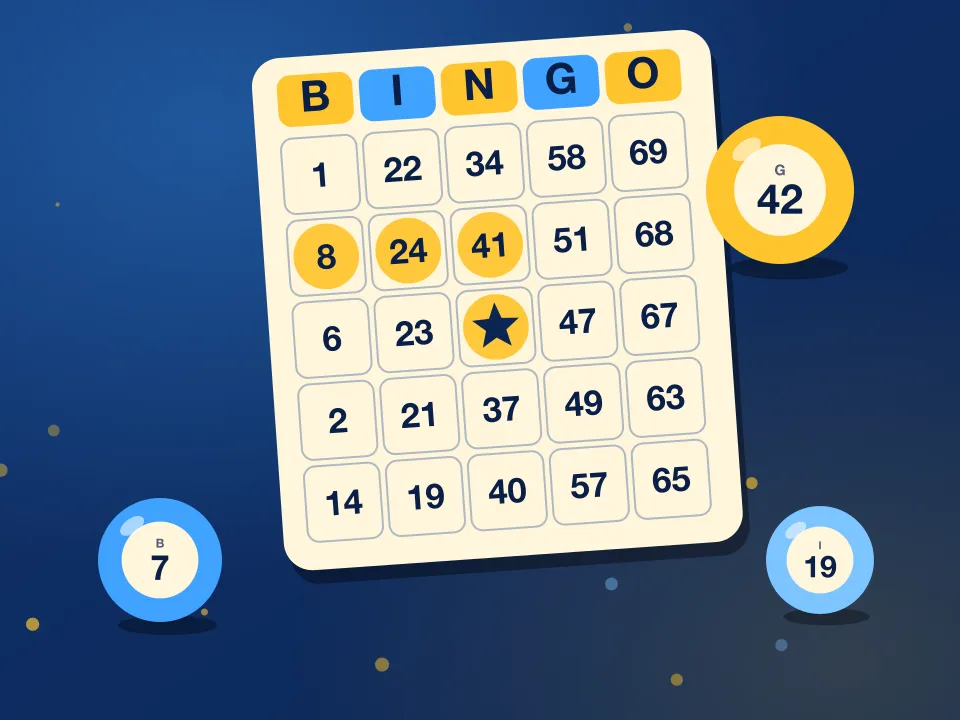
75 ball bingo is the standard game in PAGCOR’s hall framework: a 5x5 card, a free centre and balls numbered 1 to 75. Here is how the card and the draw fit together.
75 ball bingo: the card and the draw
Picture the card as five columns, each owned by a letter. B takes numbers 1 to 15, I takes 16 to 30, N takes 31 to 45, G takes 46 to 60 and O takes 61 to 75. The middle square of the N column is the free space, so the N column holds only 4 numbers.
The balls come from a pool of 75, drawn one at a time through an electronic ball blower, according to PAGCOR’s hall rules. When a number comes up, the caller says it with its letter, such as N 38, and you look in that one column.
| Column | Range | Numbers on the card |
|---|---|---|
| B | 1 to 15 | 5 |
| I | 16 to 30 | 5 |
| N | 31 to 45 | 4 plus the free space |
| G | 46 to 60 | 5 |
| O | 61 to 75 | 5 |
75 ball bingo lines: 12 ways to finish
A line is five squares in a row, column or diagonal. That gives 5 rows, 5 columns and 2 diagonals, so 12 lines in all.
- The middle row, the middle column and both diagonals pass through the free space, so each needs 4 numbers.
- The other 8 lines, the four outer rows and columns, need all 5 numbers.
The difference shows in the average finish. For a pattern of k numbers, the expected call on which the last arrives is k times 76 divided by k plus 1, so a 4-number pattern is about call 60.8 and a 5-number line about call 63.3, as an Example for one card.
Playing 75 ball bingo in a Philippine hall
In a hall, the pattern changes from game to game, and the program lists each one. You may play a short pattern like four corners, then a bigger frame, then the whole card in a continuous game.
Keep your cards in view and mark quickly. The pattern pages show what each shape needs, and the claim rules page lists the rules that decide a claim.
A hall may run 10 games in a session, each with its own pattern in PAGCOR’s program.
Mistakes to avoid in 75 ball bingo
| Mistake | Why it hurts | Fix |
|---|---|---|
| Looking at every column for each call | You fall behind the caller | Read the letter, scan one column |
| Forgetting the free space | You wait for a number you do not need | Count the centre as marked |
| Marking the wrong card | A false pattern, a void claim | Mark one number on every card before the next call |
Most players find the rhythm within a few games, and the habit of reading the letter first is the one that pays off most.
Call it in three moves
-
Read your card
Check that each column holds numbers from its own range and that the centre square is free.
-
Follow the 75 balls
Mark each called number as it appears, noting the letter so you scan only one column.
-
Match the pattern
Watch for the announced shape, and call BINGO when it is covered.